Why I am shunning Women’s Day

A day before Women’s day, I got a press release pitching an idea about women tweeting in the Twitter-verse. An idea meant for Women’s Day. And this is how it began.

I write to you on behalf of my client, Twitter and a possible tech feature on Women & Social media for Women’s Day edition.

We have often joked about the quintessential Indian woman and her conversations which are deemed loud, exaggerated and never-ending. One wonders how some of these argumentative ‘bhartiya naris’ are able to succinctly put their thoughts on Twitter in just 140 characters. Not only have they taken to this platform in great gusto, they have risen above the din and become celebrities with large followers. Young girls, suave mothers, aspiring comedians, successful entrepreneurs, fervent feminists of all hue and shades are present on Twitter, eloquently and effectively airing their thoughts, advice, jokes, tips etc…”

IMG_20131228_163739

The email went on to give names of women on Twitter who have been doing spectacular work by themselves or for their gender, or for society at large. But I didn’t even read those women’s names because of the above paragraph. My head swam with a senselessly violent anger, the kind which I would image someone as destructive as Kali would feel. Where reason takes flight, scared. Where words just. don’t. express. it.

Yes. I get kind of nuts when faced with such obvious chauvinism in something that’s supposed to be about women. Exactly the kind of unreasonable, emotional woman that men make fun of in my gender. For the people who are We in the paragraph above, is not me. I am not a reasonable, powerful man, who has language at his disposal. The one who calls women’s conversations “loud, exaggerated and never-ending”. Or calls women different, or the other gender, or the ones who don’t have a penis. Or makes jokes about them about their loud mouths, their sagging or perky breasts. Their weaknesses and bangles. Their clothes or lack of it. Their faces and lumpy bodies.

Or keeps her happy with a day from 365 days. Makes March the Eighth especially about them. This day is for women, reserved. Let’s celebrate women. Let’s tell them we love them. Let’s hug them, keep them safe, buy them clothes and greeting cards. Who is the we in this conversation? The one who is generous enough to grant the other gender just a day out of 365 such days? When did the word ‘gender’ became ‘women’ and ‘women issues’?

No, the we is not only men. It’s also women who speak the language and give the reasons created keeping men the primary gender. Women who uphold and encourage patriarchy thinking and behaviour. The ones who whisper about other women who wear short clothes, show breast or bum cleavages. The ones who like to get  their period things in a black bag while looking away apologetically. The ones who call the women who have sex ‘sluts’. The Women’s Day is for them. Not for me.

I have decided to shun Women’s Day and my gender. I stand today, genderless. Not a woman, definitely not a man. Just a body with breasts and a lot of anger. 365 days a year.

The rape of Meghalaya

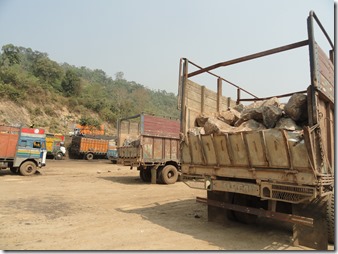
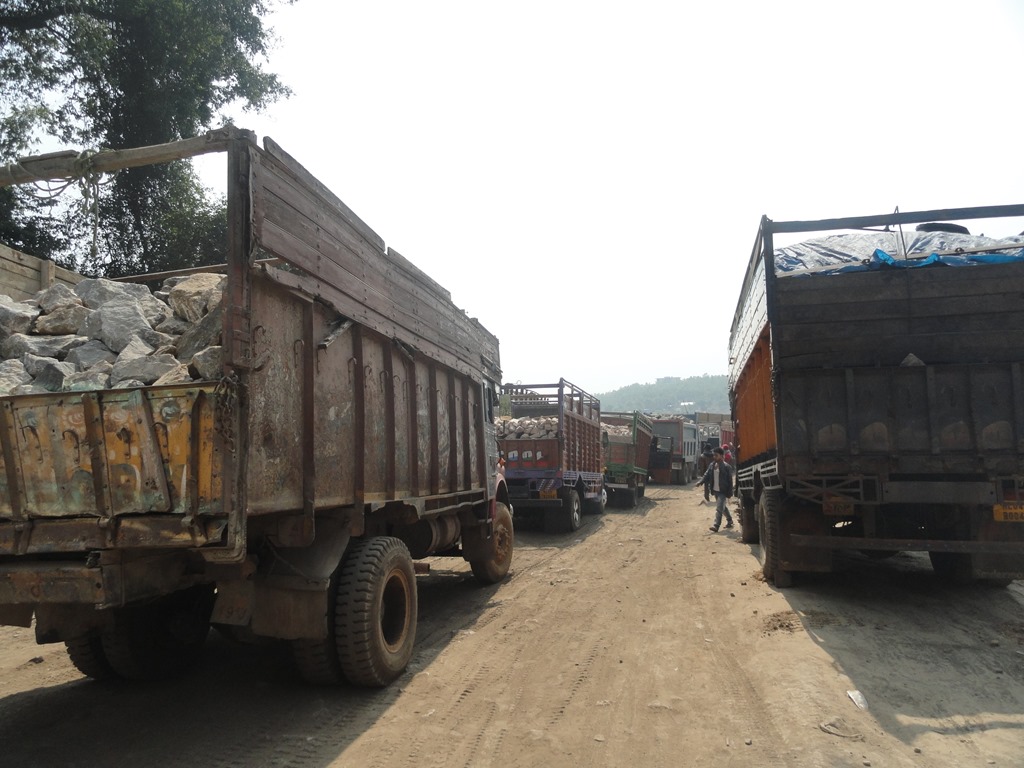
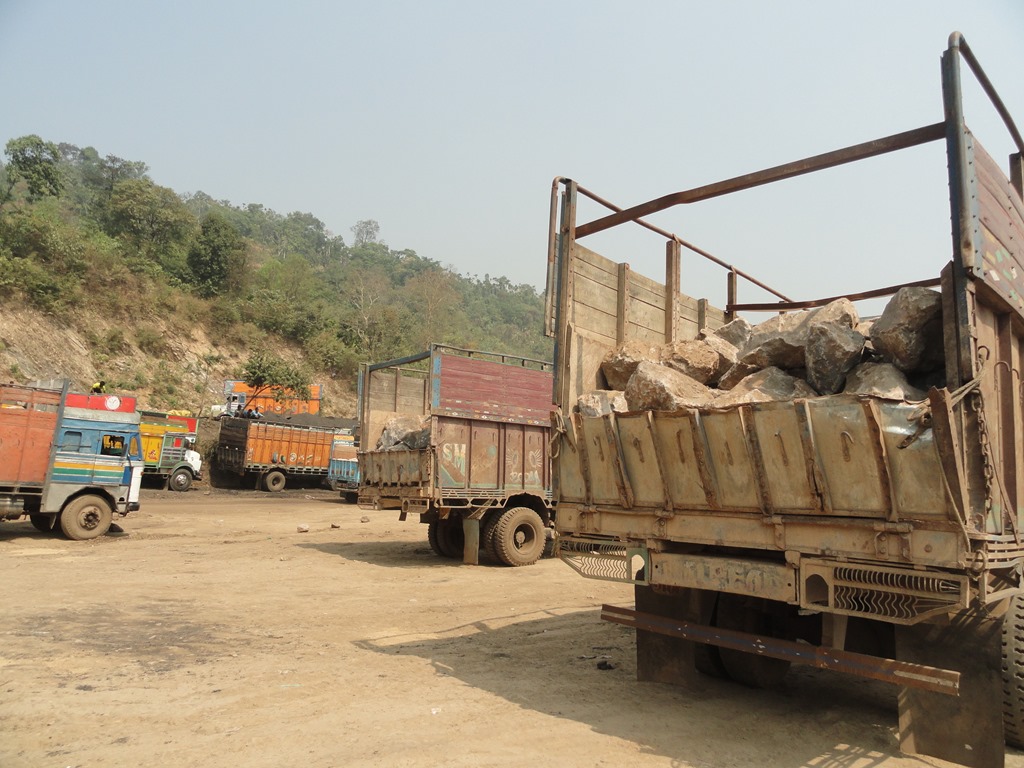
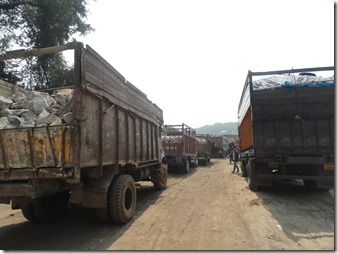
Eight hundred dumper trucks filled to the brim with coal and limestone stand on the Indian side, patiently waiting to cross the border into Bangladesh and dump their load. That’s all they do, day in and day out. Pick up limestone and coal, dug out from the mountains of Meghalaya, head to the border at Dawki, cross into Bangladesh and dump it there. To be exported to China or be made into cement. Who knows? Who cares? The politicians, the landowners, the people of Meghalaya are making money. They are beginning to buy bigger cars and other good things in life.

The mountains of Meghalaya, are old, more ancient and wiser, more mysterious but also kinder than Himalayas.  Perhaps that is why they do not protest to being drilled, cut, stripped of their soil and stone. Maybe because it’s all legal: as in each truckload is given a wadload of paper, stamped by the government. Papers, dead trees license the owners to cut and grab and gobble.

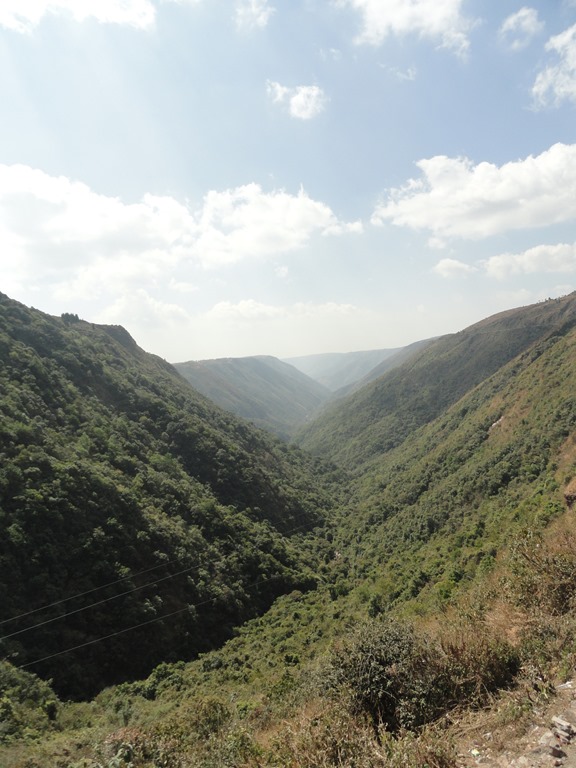
‘The people who own the mountains are selling them,’ a guide we meet on the way to Dawki informs us. We stand on a high road, for a chai break with the valley on one side and the lush green curvaceous mountains behind. His voice is one of acceptance. ‘They were the ones who made gold by buying when the government was selling the mountains. Now, they sublet it to the contractors and they sell the land.’

By selling the land, the guide means, mining it away, selling the raw materials that might be lying in the womb of the mountains, that had been created and took hundreds of years to be created. All to be gone, in twenty years of senseless human greed.DSC00200
DSC00199

DSC00205

(Trucks and trucks some more. All off to Bangladesh with loads)

‘Ten years ago, there was less of this, but it’s been increasing. The government wants it and the people who own the lands want to do it. ’

‘Doesn’t any of you protest against this?’

‘It’s not ours. The landowners are selling their land. Who’s to stop them?’

After that, a few men from Maharashtra, whose guide we have been speaking to, mutter about politicians and rich people and their greedy hearts. Their tea is finished. They try to throw the plastic cup across into the valley, but we point to a dustbin. The mountains, standing infront, look at it all, at us with our meaningless conversations as tourists who are equally disruptive on their ecology, at the trucks that roll heavy over them filled with stolen chunks of them and remain silent, patient. How can someone own the mountains? But then, how can we own anything of the land? But we do, don’t we?

At the border, at Dawki, the roads are mere trails of mud covered with long lines of trucks filled to the brim, waiting to cross the border and an equally long line coming from Bangladesh emptied of their load. We walk through the slush, dust clinging to everything. There are no tourists here, only silent eyes of men, labourers, or truck drivers. On our side, a long series of huts, with chairs and tables and typewriters and printers. To make the stealing official. To give it a seal, the seal of India’s government. To show, to cry out, to the mountains perhaps, that it’s all legal. That they’re all good men.  We are hesitant, even afraid, not sure how far we can walk. after all, the tourist stays in similar spaces, with other tourists. This is not that space. This is business, this is industry, this is supposed to stay hidden in dusts.

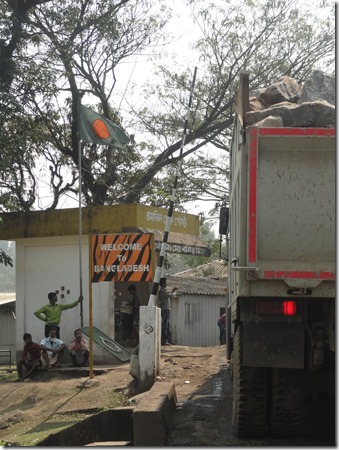
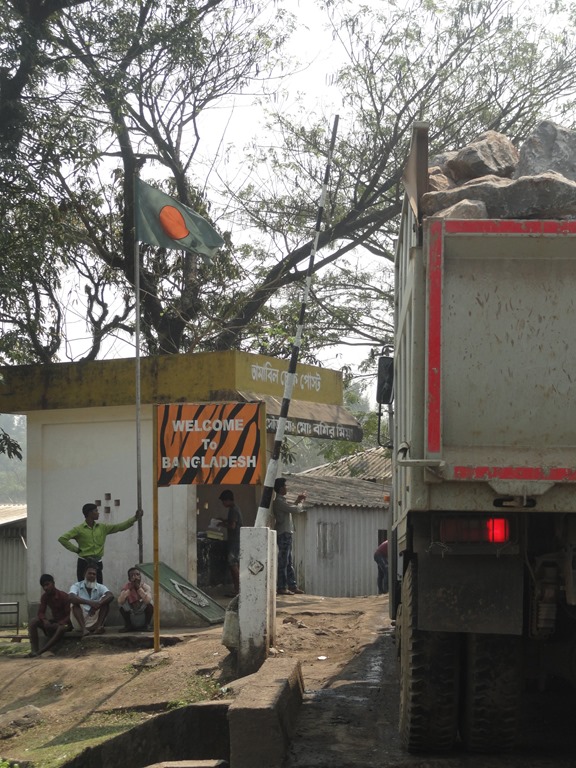
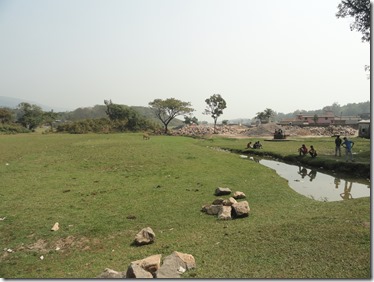
The border ends in a valley. A gate at one side, welcoming people to Bangladesh. We stand at ‘our’ side. The policeman in the hut, looks up.

‘What you want?’

‘We want to see.’

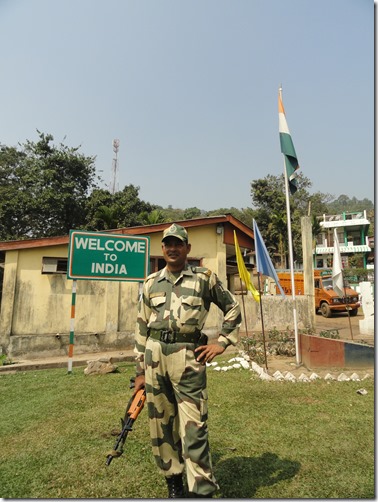
‘Ok,’ he says, to our surprise asking the BSF fellow with a gleaming, polished gun to show us the ‘border’. The BSF jawan is helpful, from UP, and waiting for just such an opportunity to jabber. He tells us how people across the border wait, day in day out, young men to cross the border.

‘Illegal immigrants?’ I ask.

‘No, no. They want to get booze. You see Bangladesh is a Muslim country and drinking is not allowed. Poor fellows want to drink. Sometimes they beg us to look the other way so that they can cross the border, get a fix and return. But I do wish that there was a fence between the borders. Right now, all there is are marked stones. It makes manning these fields rather impossible. But who’s to say. The upper echelon bosses want it this way.’

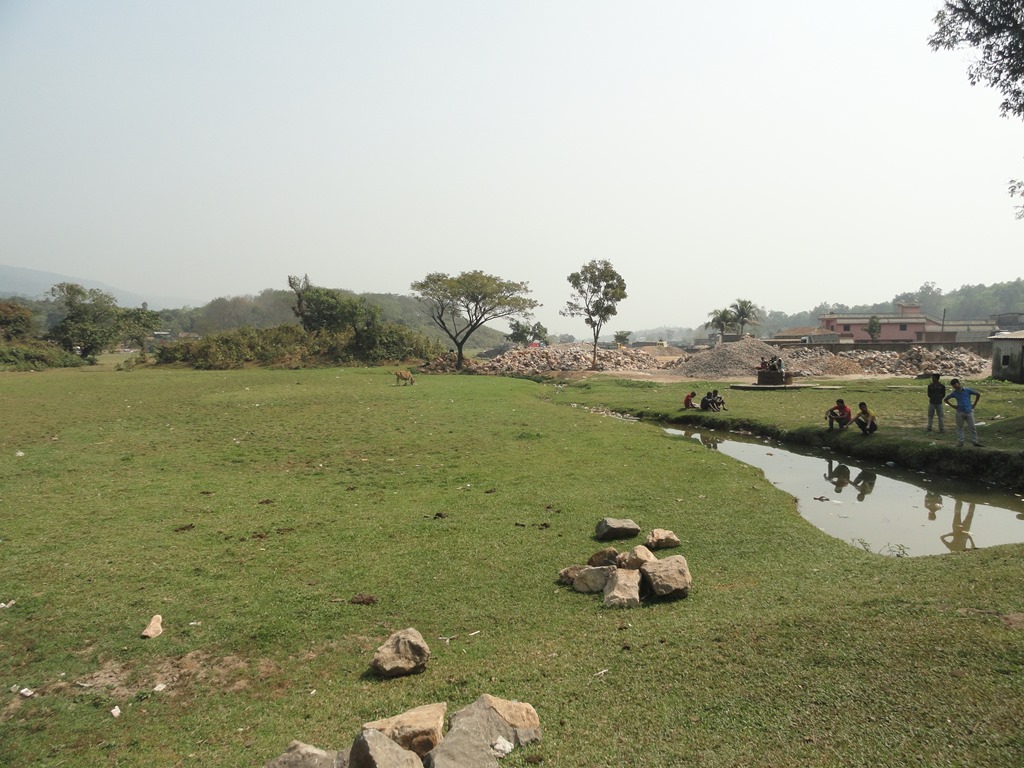
Cows graze in the flatland between the two countries, moving seamlessly from one side to another. No passports required for them, unlike us. A family from Bangladesh with a suitcase approaches the Indian side. Tourists, we are informed. ‘You can also go to the other side. It’s visa on arrival for both the countries,’ says the BSF guard. We, the city people, crib about how the government is mining the mountains away and no one seems to care.
DSC00204

(The border at Dawki)

DSC00206

(Our helpful BSF jawan)

‘The government is too greedy. they can make cement here, in Meghalaya, give work to more people, but they dig and sell the motherland away in peanuts. From Bangladesh it goes to China, the raw material, the earth. Why don’t they make cement here? She’s our mother, but no one cares about the mother now,’ he says wisely. ‘They don’t understand that we will lose the vantage point, the height of the mountains. Then they will attack and enslave us all. You see, madam, in a generation, we will be desperate to enter their country like the Bangladeshis want to enter ours now.’ We nod, and see and click pictures refusing to shrug off the tourist in us. He poses for us, still proud of his country. Not the people, but the country—his mother. He’s been trained to be proud.

Back in Shillong, my heart is still somewhat heavy. Even the lovely cottage I stay in, doesn’t cut it. I chat with the owner of the cottage, a lady who lives in Shillong and Bangalore.

‘Is there any activism in Meghalaya at all? Is anyone protesting this mining away of hills like in Karnataka?’

‘No one, dear,’ she says, kindly. ‘They don’t seem to see beyond the riches. What you saw was legal. The Jaintia hills have illegal mining of the forests and mountains by terrorists and we have no idea how much, since there’s no tracking, no paperwork.’

Me, with my privileged outlook, do not understand why. Why do those with trees and mountains and fresh air want to sell it off? Not hoard it, make love to it, cherish it. A college-dropout from Manipur, who meets me in the airplane back home, gives me the answer.

‘We want development,’ he says.

‘What kind of development? Jobs? What else?’

‘Jobs, yes. But development. More.’

He cannot express it but when he talks about Bangalore, a city of malls, traffic, people, energy, colour, human bustling, his eyes shine. For him, from Manipur, from Imphal, from the quiet mountains, the city life is the lure. He craves for that, just like me. I have lived in cities all my life and I love it. Can I live in Dawki? I don’t think I can. But I do dream of mountains and greenery and forests and trees. And a part of me wonders if we, the human race, with our greedy cravings, are going terribly wrong, somewhere.

So here’s a poem to perhaps express what my sentences could not. Perhaps not.

Dirty are the fingernails

Filthy

Not with the earth

But with jaded greed

Dead and dried

Of all emotion

Of everything

But the desire to own.
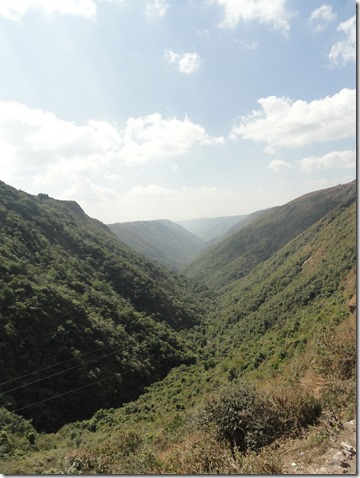
DSC00058

Shovelling, cutting, whirring away

They claw the mountain side

Screaming in their destruction

Unbinding that which binds

Destroying that which gives life

For something that cannot be eaten,

Cannot be shat out

Cannot sustain life


For the coin, for the note

For the greedy eye.


I do hope this blog, somehow, somewhere, shows me or someone else a way to somehow stop it. With some hope.

Wordless

My words are gone

Only a trembling remains

In my hands, slight epilepsy

In my eyes, a silent burst

Of emptied mind

Of thoughts no more.


IMG_20131229_152857

For gone are the words

Flung away letter by letter

Torn off, screeching, screaming

Taken to the recesses

Burnt alive

Hacked to pieces

Crushed and then buried.


They lie under the earth

Not breathing anymore

Not hearing the sighs

Nor feeling the caress

Of the motherly winds

Suffocated

Dying

But not yet dead.


Waiting, patiently, tirelessly

To be believed in

By dreams and hopes

So that they can start

Create and make

When things need a shake.


2014

The story of us

There’s nothing more romantic than remembering the things you did together as a couple, be it something as simple as holding hands or jumping off a plane to skydive. This Valentine’s Day, we suggest you put together your memories in a beautiful personal story for your partner. Here are the apps that can help you in the process.

dualcam--621x414


Glossi

photo

Announce your love through an online glossy. Create a magazine of your relationship with Glossi, a free digital platform which lets you drag and drop images, videos, PDFs, audio and animations into layouts inspired by fashion magazines, catalogues and even travelogues. Then add in links, headlines and write a poem or two and you are ready to gift a personal magazine to your partner. This online format can be shared on all major social networks, embedded on blogs and websites and viewed on tablets and mobiles.

Glossi.com, free.

Timehop

photo

How about a time capsule of your relationship? Especially apt for relationships which have seen a few years, you can walk down the memory lane together by seeing the photos and updates from last year’s or last to last year’s Valentine’s Day that you spent together. The app takes your content from Facebook, Instagram, Foursquare, Dropbox, Flickr and iPhoto. Then it syncs your images together on a Mac. Once you’ve got everything set up, Timehop will show you all social activity on a particular day. It also automatically shows you good times from your past—the app will pick up a post or a photograph which was popular with your friends and feed it into your phone’s app.

Timehop.com, free on iTunes.

Heyday

photo

Forgot to make an extra effort before Valentine’s Day? Plan the day with your partner and then using Heyday automatically record all your moments together. Launched in December, Heyday will stitch your moments with each other by keeping track of the places you go to and the things you see. It also automatically picks up the photos you took with your phone in all these places and creates collages with them putting it all together in a timeline. You can customize the collage with layouts and filters and then surprise your partner by mailing it to her/him.

Hey.co, free on iTunes.

Memloom

photo

Tell your partner how special she is by creating a personal story for her using Memloom. Launched in January, Memloom is a storytelling tool where you can upload the various moments in your relationship, including pictures, audios and videos. Now using one of the layouts offered, stitch them together in a magazine-like format. Add audio narration to give it a personal touch.

Memloom.com, $2.95-9.95 (around Rs.190-620) a month—free for up to five stories— available on the iPad and Web.


Read the complete article on Livemint.com

Brain or the sexy body?

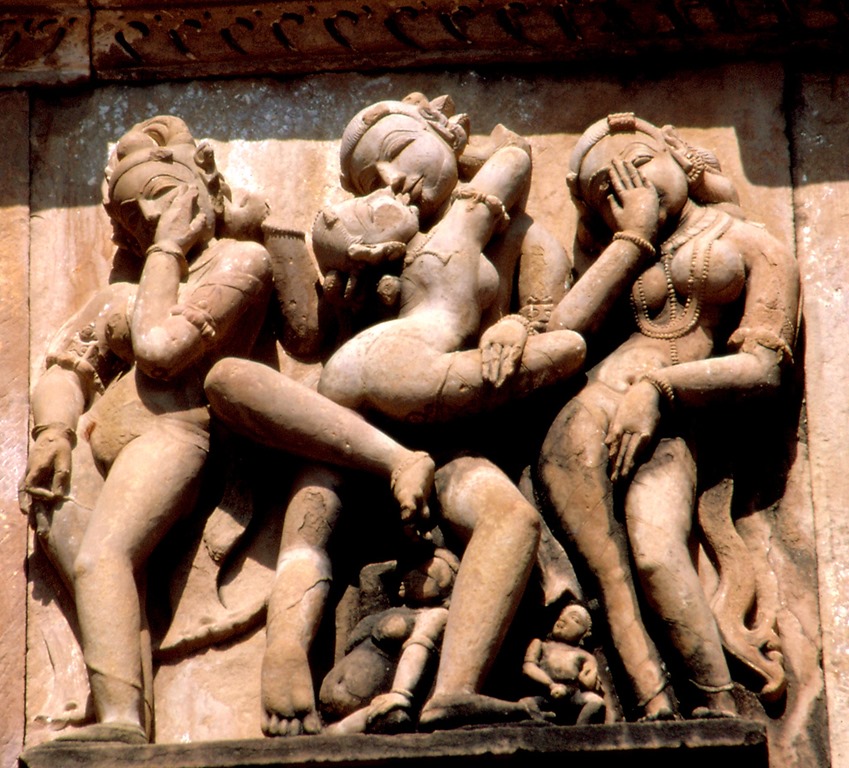
Sexuality simmers in ancient tales of India. While I was researching for my current book (a series based on tantrism), I came across the lovely tale from Vetala Panchavimsati, an older version of Vikram-Betala stories.

In a temple in the city of Shobhavati, through the favour of Goddess Gauri, Prince Dhavala marries Madanasundari, the daughter of the king
named Suddapata. Svetapatta, Suddhapata’s son, one day proceeds to his own country along with his sister and her husband. On the way they come across another temple of Goddess Gauri. Dhavala goes into the temple to pay homage to the Goddess. There he happens to see a sword, gets obsessed to offer his head to the goddess and does the same. When he does not return for long, Svetapata enters the temple and gets stunned to see Dhavala dead and his head presented to Goddess Gauri. Through some irresistible urge he also cuts off his head and presents it to the Goddess.
After waiting for a long time for her husband and her brother, Madanasundari goes in to beg something of her. She requests the Goddess to restore her husband and her brother. Hearing this Goddess Gauri asks her to  set their heads on their shoulders. But out of excitement Madanasundari puts the head of her husband on the body of her brother and that of her brother on the body of her husband. Both of them come back to life as such. Madanasundari then realizes her mistake, but what has been done cannot be undone. At this stage Vetala asks Vikram, ‘Who is Madanasundari’s husband, the man with her husband’s head, or the man with her husband’s body?’ The King’s reply is that the person with Dhavala’s head on his shoulders is the husband.


khajuraho_chitrasana

Girish Karnad got inspired by this tale and created his play Hayavadana. The story has been taken thanks to scholar K Mangaiyarkarasi’s research paper which compares this tale with Girish Karnad’s interpretation of it. It’s fascinating how richly coloured our myths easily exploring even taboo subjects. The story swims with incestuous undertones as well as questions one’s idea of ‘husband’ and ‘wife’. By today’s high prude standards, it’s insulting and could get someone into jail, even because of retelling of it.

Another thing that next ceases to amaze me is how tantrism and its esoteric cults in this country represent the breathable spaces, the perforated gaps in the suffocating, prudish morality of today. Which is perhaps why the cult is considered evil and seen upon with fear.

Meeting artist Paul Fernandes

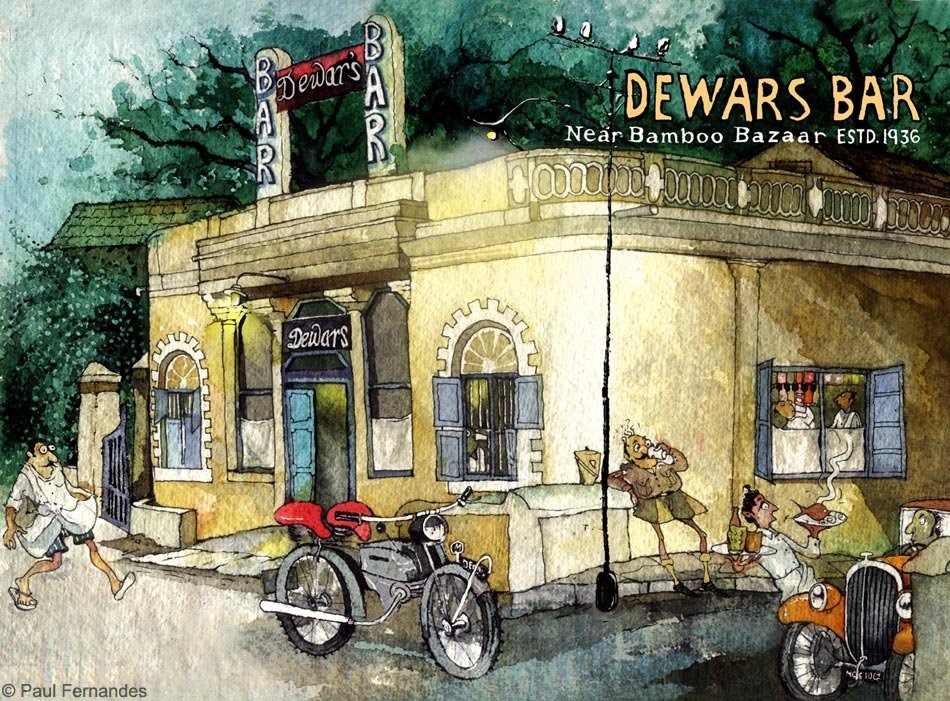
Till last year, I didn’t know who Paul Fernandes was, though I had seen his artwork all over Bangalore, occasionally colourfully covering up a bland restaurant wall or even an old space. I loved his work, without realising it was his work. Then, on a day walking during lunchtime, I stepped into his shop at Richard’s Park and connected all the humourous comic chronicles of 70s Bangalore I had seen strewn around in Bangalore. (And fell in love with a bag, but that’s another story). I stayed, my eyes crinkling with laughter at each of the framed poster.

3DewarsBar-jpg_163242

As I left, I saw a man standing outside, chatting with the manager of the shop. He looked like any old man, white beard, unassuming kurta and a khadi bad slung around his chest, standing next to a moped.  Being the curious girl I am, I stood in the circle too, chatting about old bungalows and how hard it was maintaining them. Afterwards, over lunch my friend told me that the person we had been chatting to all this while was Paul himself. I turned back as if to see him again, and imagined an unassuming man who could be missed, lost in a crowd. Everything lost, except for the satisfied smile. This was eight months ago.

Then August happened and my debut novel The Ghost Hunters of Kurseong released. In December, my graphic novel The Skull Rosary released. Two releases in the market meant a lot more of marketing. Ever since then, I have had to struggle with my writing. My time travelled between one more online update, one more connection in the marketing industry and then one more chasing the journalist who wouldn’t remember my name. In the lists of neverending tasks-to-be–done, my writing (the reason I quit my job and career in journalist), lay in a corner, gathering dust and wondering why it was being ignored.

So it was with a heavy, confused heart that I was at the Times Literature Carnival last Sunday. I had been feeling lost since  a couple of weeks (my wise mother named it rat-race of the author’s world), not getting enough time to get into the blackhole that is required for creativity. Not able to switch off from the constant stream of social updates as well as public updates that wave after wave came to my shores. Not able to back off and go back to the closed room.

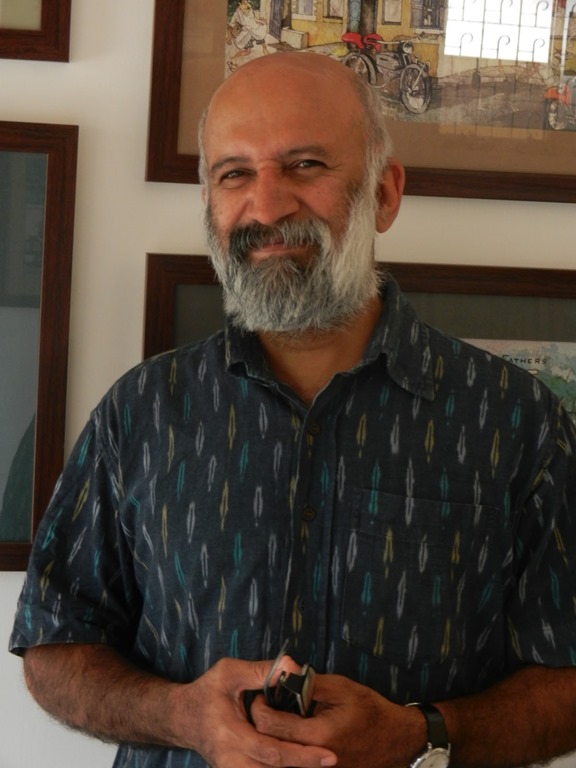
Then I saw Mr Paul Fernandes, standing in a corner, smiling at the festival. The same smile I remembered from the sunny day in Richard’s Park. I headed to him and made conversation about this and that. All the time my mind was whirling, at unrest, wondering. Finally, with a deep breath, I said it.

Paul Fernandes 1

‘Sir, can I ask you something? It’s sort of vague and personal but I just have to ask.’

He nodded. My cue was here and my best bet was to be as expressive as possible.

‘Sir, how does one balance marketing with creative works? I mean, once there’s certain level of success, once you have achieved the first step of success, how do you stop that ambition from taking root and go back to your work? What you loved doing in the first place? Writing for me and painting for you? How do you switch off?’

‘Me? I just love what I do. I love to draw and so I do it.’

It wasn’t enough. I needed more.

‘But sir, how? How do you switch off?’

‘Well, I go back to my table, see all my pens and papers strewn around and then leave the world outside. I close the door.’

‘But sir, how do you control ambition? I mean I have a certain level of success, but I want more. How do I stop wanting more?’

‘But, ambition is a good thing. Just leave it outside the door when you go inside.’

Such a small conversation. It took two minutes of standing in the bustling Carnival of literature but it hit home. I left smiling, suddenly lighthearted after so many weeks of this heavy stone in my heart. It wasn’t that I didn’t know this before, but when Mr Fernandes said it, it just somehow hit home. And so I decided to close off everything, all tasks, all lists, all the world, and close to door, with only my paper, pen and laptop for company. It was hard before, but suddenly, after hearing it from Mr Fernandes, it became so easy. Thank you, Paul, for that.

Paul Fernandes is one of Bangalore’s well known illustrator and artist and cartoonists. He has illustrated many books, including On a High Note and Peter Colaco’s Bangalore. To see his work, head to his gallery in Bangalore, aPaulogy


Supercharge for office

More and more people are using their cellphones as computers, and if you’re carrying a “computer” in your pocket, why not put it to work? A phone isn’t always a good replacement for a computer—good luck filling in giant Excel sheets on a 4-inch screen—but there are some ways in which phones can really simplify your work life, or just take a little of the stress away. We look at new apps that can bust work stress.

office--621x414

RescueTime

If you’ve ever had a day where you go in with 10 items on your agenda and end with all 10 untouched, then you need to look at this free app. RescueTime helps you track how you’re using your phone, and can be used to identify the major distractions that keep you from getting work done. RescueTime is a popular app on Google play, with over 700,000 downloads, and its iOS version is expected to launch in February. The app is simple—all you have to do is install it and it will run in the background. You go about your daily usage without having to check the app, and whenever you want to analyse your phone usage, just open RescueTime and you can see an efficiency score that helps you easily track your progress in cutting down on distractions. RescueTime will tell you which apps you’ve been using, how much time you spend on each, and will also track phone calls, so you know exactly how you’ve been spending your time—it even lists your top distractions. There’s also a handy stopwatch to use in meetings or during exercise.

RescueTime is free with some paid features at $9 (around Rs.550) a month, on Android and browser. The iOS app will launch in February.

Talygen Business Intelligence

Location awareness and being online all the time make phones a great way for employees on the road to check in with their office. Talygen is a paid app that helps employees manage all the paperwork without any paper, so they can focus on the important parts of their job. This tool is useful for small business owners who want to keep track of on-the-road employees or time spent in a client’s office. You can track billable time, work on customer relationship management, expense accounting, manage leave and many other administrative issues.

The app, launched last month, makes it really easy for your employee to check in on the go so that you, as the manager, save time tracking. Everything is organized on the cloud and the data can be accessed through the app. The data can also generate an advanced report which can then be exported into a PDF or an Excel file.

Talygen, $20 a month onwards, on iTunes, Google play, Windows Phone and BlackBerry.

Agent

Is your smartphone’s battery always dying on you? Install this personal Agent, a smartphone app which does little things to make your phone, well, smarter. The app runs in the background and saves the battery by automatically dimming the screen when your battery signals low, automatically silences your phone during meetings, remembers where you parked your car and puts your phone to auto-respond when you’re driving. It also allows only urgent calls or messages when you’re sleeping. The app is triggered by Bluetooth and it can also read your SMSes aloud or send automatic responses, or reply to a select list of contacts only. It was launched in November, and the makers are adding more features. “In 2014, the app will be able to call you a cab right before your next meeting,” says Kulveer Taggar, CEO and co-founder, “or pay for your coffee before you get to work.”

Agent, free on Google play.

Limitless


Limitless is meant for anyone who wants to manage their time on devices better. The productivity tool, which works on Google Chrome, gives an update on how much time of the day was spent productively and how much of it on Facebook and Twitter. “We are a behavioural science company that helps users get work done,” says Anup Gosavi, co-founder, Limitless. “If the person has the desire to become more efficient in how they use their devices, Limitless can be the right productivity companion.” The tool categorizes the various websites you visited on your Chrome browser and differentiates with tags like work, social and other learning. At the end of the day, it shows you the percentage you spent in each of those sections. It also has nudges, albeit gentle, to get you back to work. Launched in December, the tool is still in its early stages, releasing updates and building up Limitless for Safari, Firefox and mobiles.

Complete article on www.livemint.com

Rearrange your online life

Click. Share. Like. Comment. Post. Redo. If keeping pace with your multiple virtual lives is getting too much for you, use these tools to reorganize them and get back to your real one. Believe us, you will thank us for it.

tech1--621x414

Swayy

This one is for the share hogs—the ones who would like to read things from the Net and share but want to avoid hopping from site to site. Swayy, which was launched in September, is a sixth-sense curating site that reads your interests, scans the Web and then serves you the best articles, videos and infographics, also sharing them with your social networks. All you have to do is log into your Twitter, add in your Facebook and LinkedIn accounts via Swayy and let its codes work in the dark to figure out what you like and who you are. “By analysing a user’s social audience and understanding what topics his/her audience are interested in, Swayy can match the user with the most relevant and trending content to help him/her share better and grow his/her online presence,” explains Lior Degani, vice-president, marketing, Swayy. That’s not all, you also get served social analytics—clicks, likes, retweets, new followers, etc.—to share better in future and figure out which of your content worked well with the audience.

Free for two social accounts; $9 (around Rs.550) a month for a paid account, which allows for scheduled posts too.

ThinkUp

Tired of the time they were spending on Facebook and Twitter, the founders of ThinkUp decided to build an app to connect all social networking accounts and sort out the crazy stuff that is posted on them every day. ThinkUp, which launches today, uses bots and smart code to show the most relevant information from your social networks on your screen. So you don’t have to scroll Facebook and then Twitter, and then Instagram, to find out the things that are most important. More than that, ThinkUp also tells you who your biggest online fans were per week, whether your old profile picture was better than the new one, or if your friends like it when you post quotes from famous people. It gets the delight back into the social.

A paid service that costs $60 a year.

RebelMouse

An open-ended space, in its simplest form RebelMouse can be used to collate all your social media streams and put them together in one place for you to see. But that’s not all it does. “We are a full publishing platform that lets you simply create great content and have a beautiful site, mobile Web experience, engagement tools and an analytics suite that is actionable,” says Paul Berry, founder and CEO, in an email interview. With three simple clicks, you get your content from all over the Web on one page. After that, it’s up to you. Do you want to make a website of all the content you are constantly getting? Do you want to curate and clean up and then share it seamlessly with all your social networks? Or embed in an existing website? Or do you want to make a campaign out of it? RebelMouse lets you do all this and more. No wonder the site reached 17.5 million unique visitors in December.

Free for individuals to curate, create and share across social networks. $500 upwards a month for brands.

Flavors

Instead of giving multiple LinkedIn, Facebook, Twitter, Google+ Ids to a stranger who wants to connect with you, give them one: your website address. As the name suggests, Flavors.me brings together all your myriad faces in the digital world on to one website and gives you a unique URL to print on your visiting card. The platforms they recognize include social networks (Twitter, Facebook and LinkedIn), location-based networks (Foursquare), blogs (Tumblr, WordPress, Blogger and Typepad), photo-sharing sites (Flickr and Picasa), video-sharing sites (Vimeo and YouTube), even audio-sharing sites (SoundCloud, Last.fm, 8tracks and Mixcloud). Basically, anywhere you might be present. Once you create a log-in Id, go step by step in choosing a template and finalizing how your site looks with social media streams…

Read the complete story on the livemint.com site

The Skull Rosary nominated for two awards!

There are times when you write for the heck of it. And then there are times when you are forced to write just so that you can somehow, somewhere collect, announce, record, and remember all the awesome things that have been happening to you. This one is a latter kind of a post. A lot many good things have been happening to me and I am overwhelmed. So this is not to all you readers. This blog is meant for the future Shweta Taneja. Food for her days which will be bleak and black and without hope. For her to remember that good things and then bad things happen in a continuous cycle. And what’s low will go up high soon enough.

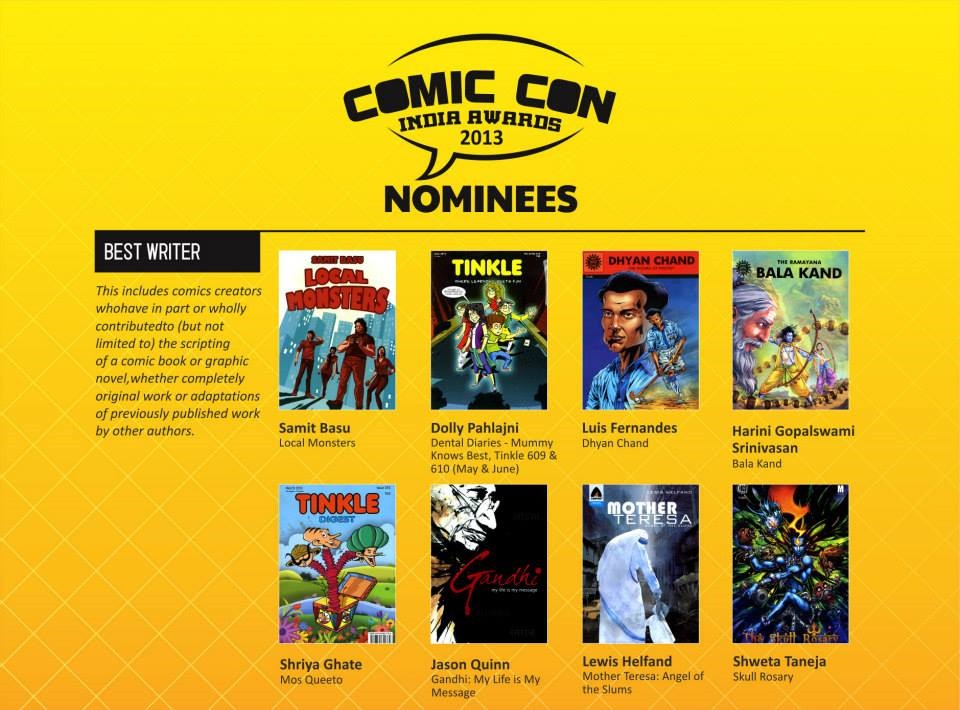
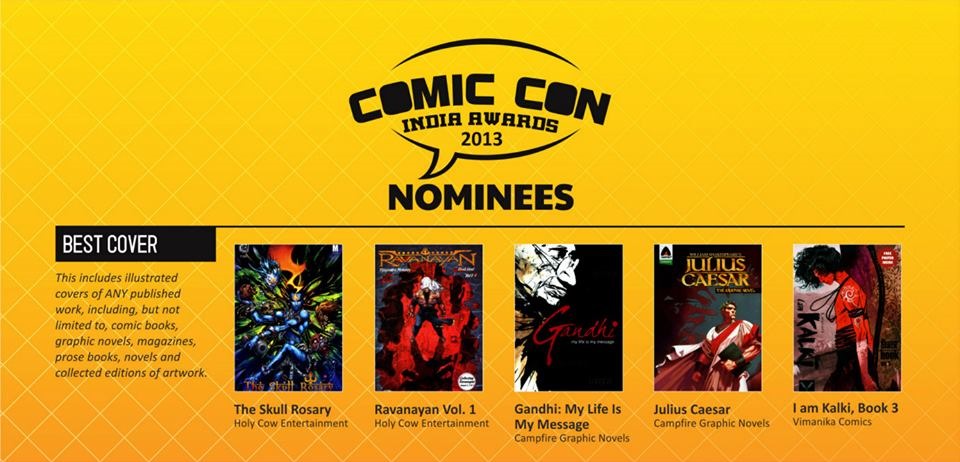
The Skull Rosary has just been nominated for The Best Writer and The Best Cover in the Comic Con India awards. The latter was kind of obvious all thanks to the amazingness made by Lalit Sharma and colourist Yogesh Padgaonkar (hello, have you see the cover?). But the first one comes as a delightful, extra scoop of chocolate! Am basking in the surprised glory.

1517589_697720733593219_1908216166_n

1536579_697720710259888_582380319_n

And there’s more! Krishna, Defender of Dharma was named as a must read in CBSE School Reading List for 2013. The credit goes to the awesome artist Rajesh N, who quietly works in shadows on a desk in Campfire Comics.

Meanwhile, The Ghost Hunters of Kurseong, my darling novel which was never to have been written, has been written, has been published by the awesome Hachette India and is slowly cuddling up to little ones and warming up to people in the media. Read reviews spread across the web: Citizen Matters, Niticentral, The Hindu and elsewhere. I am also doing a detective workshop for it next weekend. Come over!

And even that’s not ALL. I have managed to sign a three-book contract with a really, really good publisher for the fantasy book series which I have already dreamed to write and have written part 1 of. That will will be announced soon and separately. Meanwhile, I will go back to writing Part 2 Smile

But really, wow. Too much. Overwhelming.

Rajnikanth’s birthday, with love

Around 9am on Sunday morning as I walked to my nearby slum where I teach yoga to superbly enthusiastic kids every week, I saw a poster hanging at its entrance. Rajnikanth’s smiling face jumped out of the poster. Alongside were two words in English: Happy Birthday. It  was a small poster, about A3 size, strung up casually, hanging in the air, tilted. The poster had more love than execution (Wish I had taken a picture, but I usually don’t take my phone to the class).

rajinikanth_132315259025

Before the class began, I asked the kids who put it there and what it meant. Was Rajnikanth coming to their slum? What was the connection? One of the kids, Pratap who’s the librarian in the area too, told me that they were celebrating Rajnikanth’s birthday. They had gone around the slum, collected small bits of money from everyone and with that, bought this poster which was proudly hanging at the gate of their slum. They had also bought a huge cake and candles and were going to come together as a community, light up the candles, sing the birthday song and cut the cake.

Yes, they love Rajnikanth and who doesn’t? But that’s not the only time they celebrate. Even though most of them barely have enough food on their tables, they celebrate all festivals and birthdays together. They cut cakes, buy sculptures, dance, drink, laugh, all as a community. That’s how this community works. They do everything together. Celebrate, cry, support. I constantly get amazed about how people in this community are so there for each other. Yes, there are fights, but there’s also constant celebration.

I am an outsider. I have no community. I am middle class and in my building people nod and smile to each other, but they are too busy, with their televisions or their phones or their internets or their children or worrying about their maids or EMIs. They don’t walk together, they don’t laugh together. Take their cars out, go to malls. They look at people on the roads suspiciously. They keep the cars and the home doors closed (In that slum, the doors are always open).

So I wonder. Do the doors close and togetherness lessens because we are living in bigger houses? Or does it happen because we have money and more stuff? Do the things we have collected around us: our TVs, phones, clothes, jewellery, spic-a-span, make us suspicious of others? When did it happen that the things we collected took over our lives?